Korolev vs von Braun: The Secret Rivals Who Started the Space Race
One was a Nazi Party member who built weapons with slave labor. The other survived Stalin's gulags with a broken jaw. They never met, never knew each other's names, and together they launched the Space Age.
Introduction
Sergei Pavlovich Korolev was born in 1907 in Zhytomyr, in what is now Ukraine, to a family that fractured before he could walk. His father left when Korolev was three. Raised by grandparents while his mother studied in Kyiv, he grew up solitary, brilliant, and obsessed with flight. By the time he was a teenager, he was designing gliders.
Wernher Magnus Maximilian Freiherr von Braun was born in 1912 in Wirsitz, Prussia, to an aristocratic family with a coat of arms and a baronial title. His mother gave him a telescope. He read Hermann Oberth's "The Rocket into Interplanetary Space" as a teenager and decided that rockets were his future. He would let nothing stop him.
Two Paths to the Stars
Both men arrived at the same conclusion independently: the only way to fund the development of space rockets was to convince a military to pay for them. Korolev joined the Soviet military's rocket research group in the 1930s. Von Braun, at twenty-one, was already working for the German Army's ordnance department. Both understood that their patrons wanted weapons, not spaceships. Both took the money anyway.
The Dark Years
Von Braun's bargain with power was explicit. He joined the Nazi Party in 1937 and the SS in 1940, eventually reaching the rank of Sturmbannfuhrer. At Peenemunde, he led the development of the A-4, later renamed the V-2, the world's first long-range ballistic missile. Production was moved to underground tunnels at Mittelbau-Dora, where concentration camp prisoners assembled the rockets under conditions of deliberate brutality. Approximately 20,000 prisoners died building the V-2 -- more people than were killed by the weapon itself. Von Braun later claimed he was unaware of the conditions. Survivors contradicted him.
Korolev's suffering was not complicity but victimhood. In 1938, during Stalin's Great Purge, he was denounced by a colleague and arrested by the NKVD. He was beaten during interrogation; his jaw was broken and never properly set, leaving him unable to fully open his mouth for the rest of his life. He was sentenced to ten years of hard labor and sent to the Kolyma gold mines in eastern Siberia, among the deadliest camps in the Gulag system. He nearly died of scurvy and exhaustion. Only the intervention of other imprisoned engineers, who arranged his transfer to a sharashka -- a prison laboratory -- saved his life. He would spend six years in captivity.
The Race
After the war, both men served the empires that claimed them. Von Braun surrendered to the Americans in 1945, bringing with him 118 V-2 rockets and boxes of technical documentation. He became the public face of the American space program, appearing on Disney television specials and the covers of magazines. His past was sanitized, his Nazi affiliations quietly filed away.
Korolev received no such celebrity. The Soviet system designated him only as "the Chief Designer," his identity classified as a state secret. He could not publish under his own name, could not receive public awards, could not be photographed in connection with his work. His face was unknown to the world.
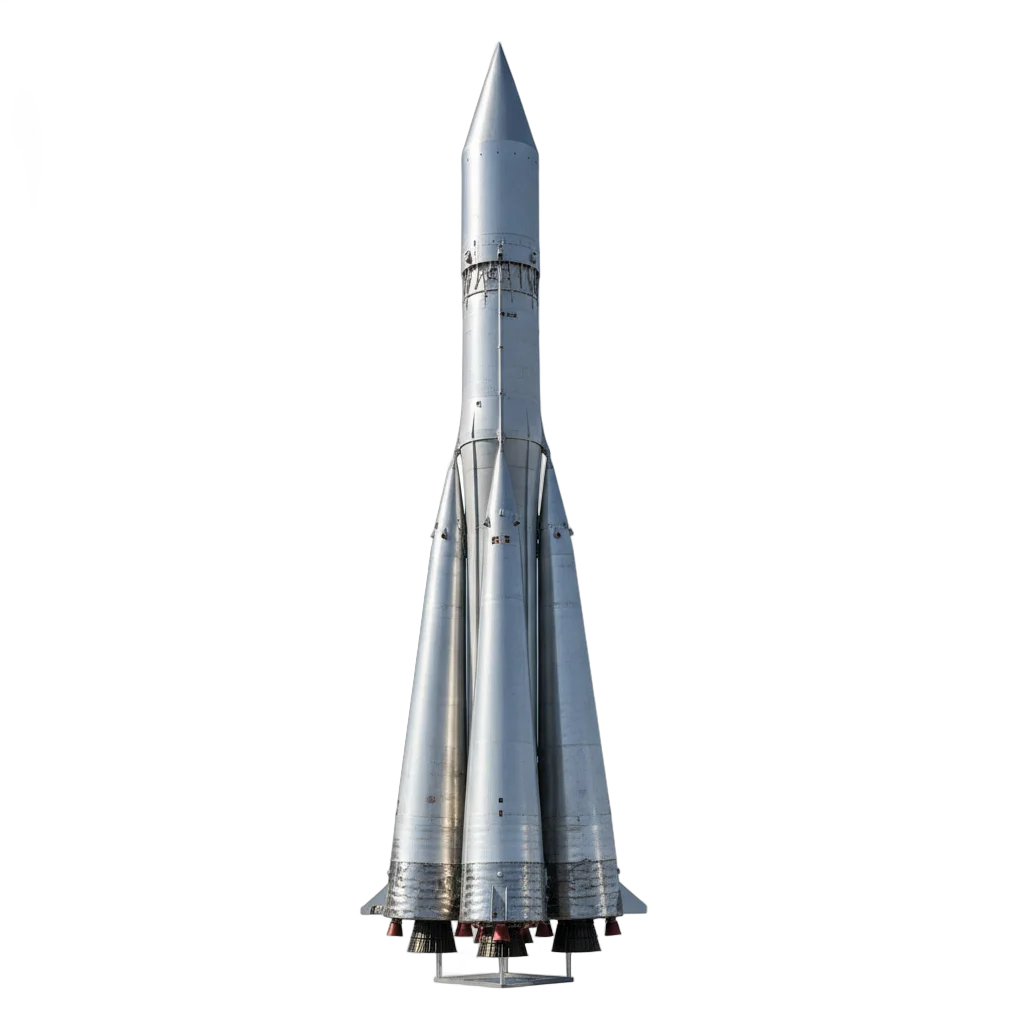
And he won. Korolev launched Sputnik on October 4, 1957, shocking the world. He put Laika in orbit a month later. He launched Luna 2 to the Moon in 1959. On April 12, 1961, his R-7 rocket carried Yuri Gagarin into orbit -- the first human in space. Every early milestone of the Space Age belonged to the anonymous Chief Designer.
Von Braun's response was Saturn V, the rocket that carried Apollo to the Moon. In the race that mattered most to the two governments writing the checks, von Braun won.
What Might Have Been
They never met. They never learned each other's names during the years of competition. Von Braun knew his counterpart only as an unnamed Soviet genius.
Korolev died on January 14, 1966, at fifty-nine, during surgery to remove a tumor in his abdomen. His identity was revealed to the world only in his obituary. The surgeons discovered the tumor was malignant, but Korolev's jaw -- still misaligned from the NKVD beatings -- made intubation impossible. He died on the operating table. Without him, the Soviet Moon program lost its driving force. The N1 rocket, designed to match the Saturn V, failed on all four launch attempts and was quietly canceled.
Von Braun was sidelined by NASA bureaucracy after Apollo, as the agency pivoted to the Space Shuttle and abandoned the heavy-lift rockets he had championed. He resigned from NASA in 1972, joined a defense contractor, and died of pancreatic cancer in 1977 at sixty-five.
Both men achieved the dream that had consumed them since childhood: to build rockets that reached beyond Earth. Both were consumed by the systems that made it possible. History does not require its protagonists to be heroes. It only requires them to be consequential.