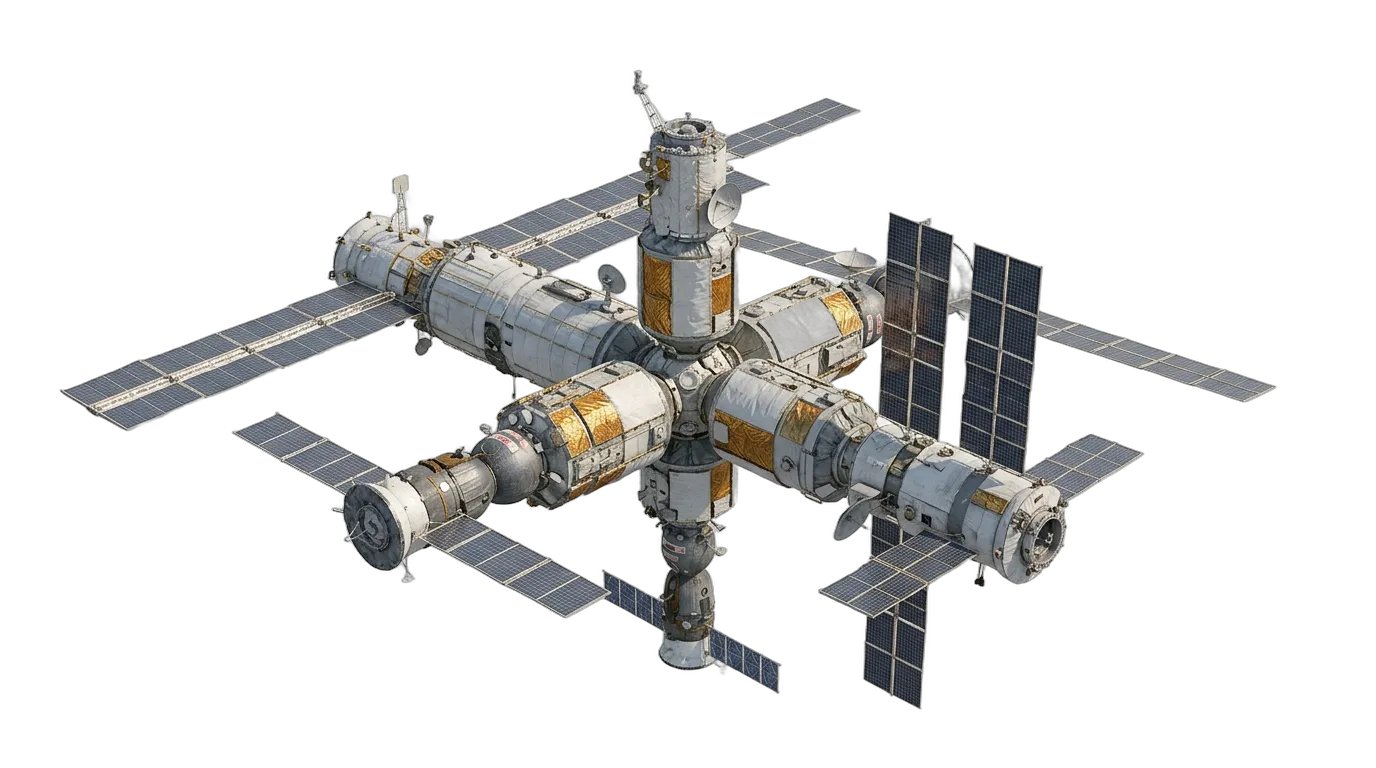
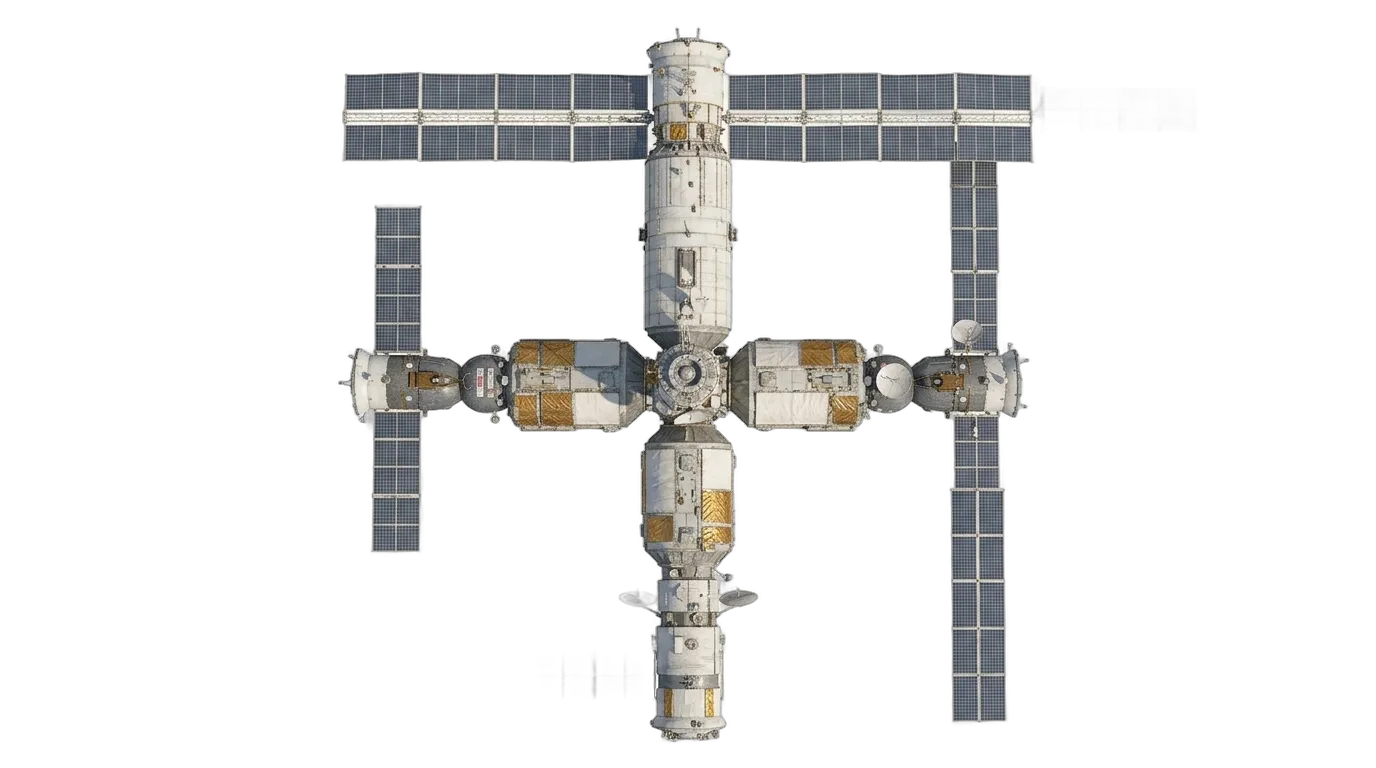
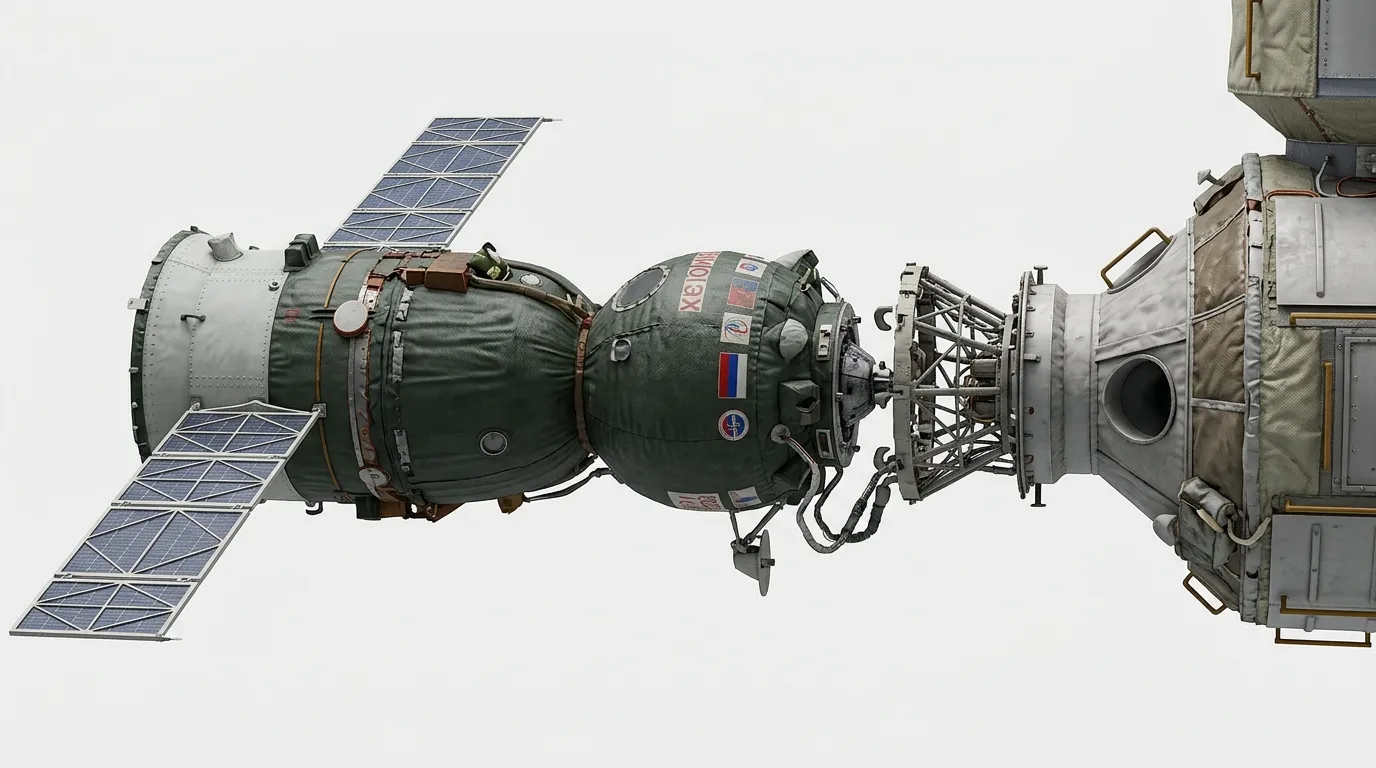
The first modular space station, assembled in orbit from six modules over a decade. Mir was continuously occupied for a record 3,644 days and hosted astronauts from 12 nations. It survived fires, collisions, and the collapse of the Soviet Union.
History
Mir (meaning Peace or World) was the culmination of the Soviet space station program that began with Salyut 1 in 1971. Unlike its predecessors, which were monolithic single-module stations, Mir was designed to grow through the addition of specialized modules launched separately and docked in orbit.
The base block launched on February 20, 1986, and five additional modules were added over the following decade: Kvant (astrophysics), Kvant-2 (life support and airlock), Kristall (materials processing), Spektr (remote sensing), and Priroda (Earth observation). The fully assembled station had a mass of over 286,000 pounds and a pressurized volume comparable to the interior of a large commercial aircraft.
Mir was continuously occupied from September 1989 to August 1999, a record that stood until surpassed by the ISS. Cosmonaut Valeri Polyakov spent 437 consecutive days aboard Mir in 1994-1995, a single-spaceflight duration record that still stands. The station survived a fire in the Kvant module in February 1997, a collision with a Progress cargo ship that depressurized the Spektr module in June 1997, and ongoing systems degradation as the station aged far beyond its design life.
In its final years, Mir hosted American astronauts as part of the Shuttle-Mir program, a collaboration that laid the groundwork for the International Space Station partnership. Mir was deorbited on March 23, 2001, breaking apart over the South Pacific after 15 years of service -- far exceeding its original 5-year design life.
Timeline
Launch Heritage
- First modular space station
- Longest single spaceflight (Polyakov 437 days)
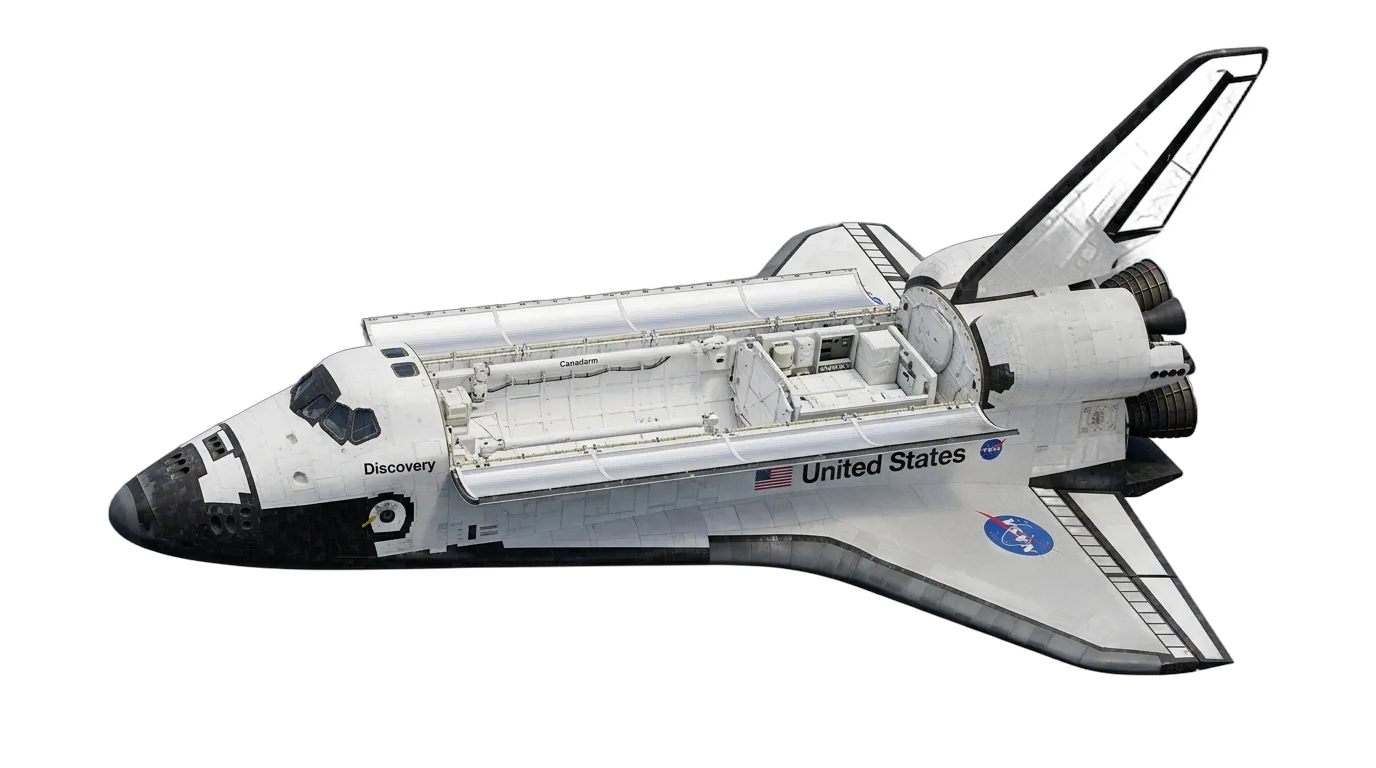
- Shuttle-Mir program
Technical Specifications
Performance
Dimensions
Mass
Mission
Power & Systems
Source: NASA History
Tags
Designed by NPO Energia / RSC Energia