The Hubble Rescue: Five Missions to Save the Greatest Telescope
Launched with a flawed mirror that made it a national joke, Hubble was saved by astronauts who performed orbital surgery in bulky gloves. It became the most productive scientific instrument in history.
Introduction
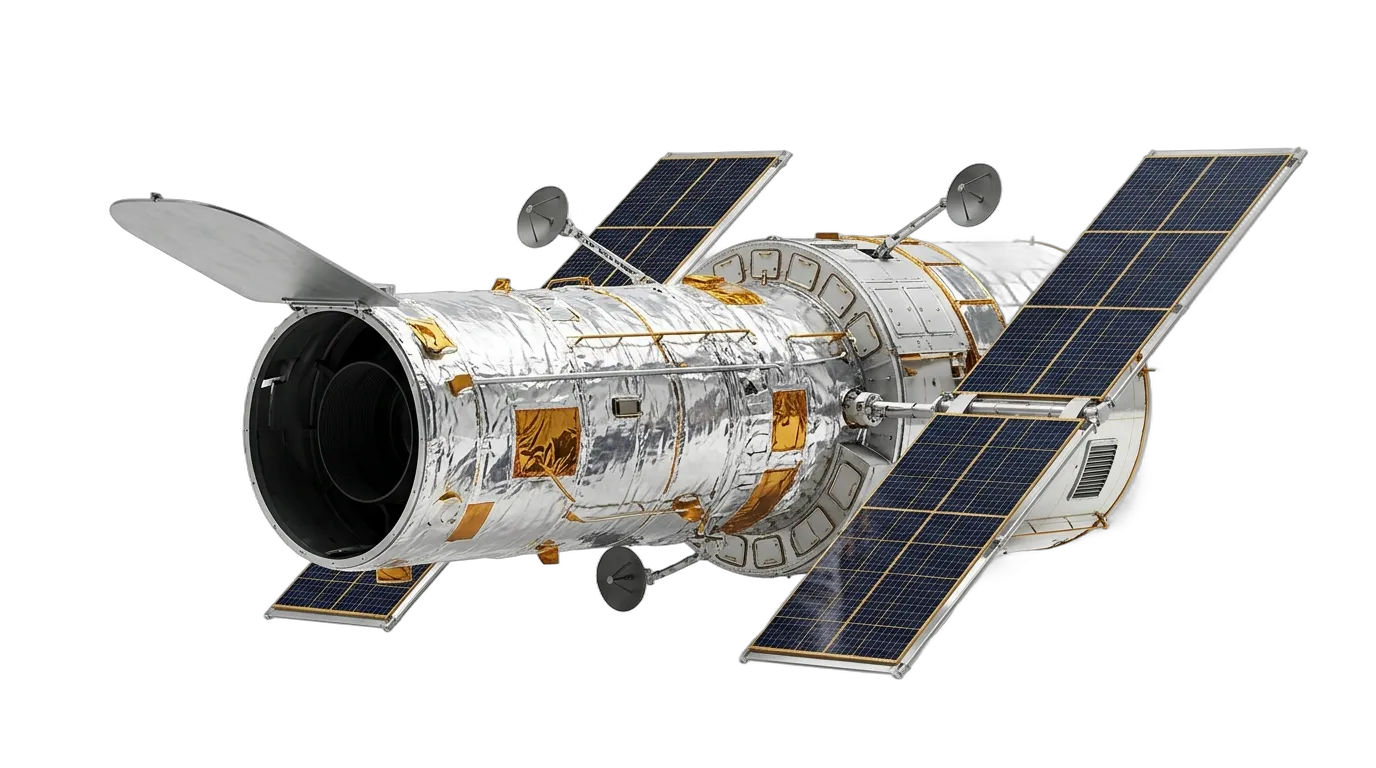
On April 24, 1990, the Space Shuttle Discovery carried the Hubble Space Telescope into orbit, and the celebrations began. Hubble was the culmination of decades of planning -- a 2.4-meter mirror placed above the distortion of Earth's atmosphere, promising images of the universe sharper than anything ground-based telescopes could produce. The first images arrived weeks later, and they were blurry.
The Flaw
The primary mirror had been ground to the wrong shape. A device called a null corrector, used to test the mirror's curvature during manufacturing, had been assembled incorrectly. One lens was off by 1.3 millimeters. The result was a mirror with a spherical aberration of 2.2 micrometers -- roughly one-fiftieth the width of a human hair. It was technically one of the most precisely wrong mirrors ever made: perfectly smooth, but shaped to the wrong prescription.
NASA became a punchline. Late-night comedians mocked the agency's "nearsighted telescope." Congressional hearings demanded answers. The Hubble program, which had already cost $1.5 billion, looked like the most expensive failure in the history of science.
But Hubble had been designed with one critical feature that saved it: it was meant to be serviced in orbit by Space Shuttle astronauts. Engineers at Ball Aerospace designed COSTAR -- Corrective Optics Space Telescope Axial Replacement -- a device containing ten small mirrors, each shaped to exactly counteract the primary mirror's flaw. It was essentially a pair of glasses for a telescope.
COSTAR and SM1
In December 1993, the Space Shuttle Endeavour launched with a crew of seven on Servicing Mission 1, the most complex and scrutinized spacewalk operation ever attempted. Over five days, astronauts performed seven spacewalks totaling 35 hours and 28 minutes. They installed COSTAR, replaced the original Wide Field/Planetary Camera with the corrected WF/PC2, replaced solar arrays that were causing thermal vibrations, and swapped out failed gyroscopes and electronic components.
The moment of truth came weeks later, when the first images from the corrected telescope were compared to the old ones. The difference was staggering. Stars that had been fuzzy blobs snapped into pinpoints. Galaxies revealed spiral arms and dust lanes. NASA held a press conference and showed before-and-after images that silenced every critic. Hubble went from national embarrassment to the most productive scientific instrument in history.
Five Servicing Missions
Four more servicing missions followed, each extending Hubble's capabilities far beyond its original design. SM2 in 1997 installed NICMOS, the Near Infrared Camera and Multi-Object Spectrometer, and STIS, the Space Telescope Imaging Spectrograph, opening new wavelength windows. SM3A in 1999 was an emergency mission after a fourth gyroscope failed, leaving the telescope unable to point accurately. SM3B in 2002 installed the Advanced Camera for Surveys, which doubled Hubble's field of view, and replaced the solar arrays again.
SM4 in 2009 was the last and most ambitious. NASA had initially canceled it after the Columbia disaster, deeming the risk too high without the option of reaching the International Space Station as a safe haven. Public outcry and a new NASA administrator reversed the decision. Astronauts installed the Wide Field Camera 3, the Cosmic Origins Spectrograph, new batteries, new gyroscopes, and a new fine guidance sensor. They also repaired STIS and ACS, instruments not designed to be repaired in orbit. Astronaut Mike Massimino had to rip off a handrail that was blocking access to STIS -- a move not in the procedures -- to complete the repair.
The Results
The numbers tell part of the story: over 1.5 million observations, more than 19,000 peer-reviewed scientific papers, cited in studies across virtually every field of astronomy. No other single instrument has generated more scientific publications.
But the discoveries tell the real story. Hubble determined the age of the universe to be 13.8 billion years, resolving a debate that had divided astronomers for decades. It confirmed that supermassive black holes exist at the centers of most galaxies. Observations of distant supernovae by two independent teams using Hubble data led to the discovery that the expansion of the universe is accelerating -- a finding so unexpected it was awarded the Nobel Prize in Physics in 2011. Hubble photographed galaxies forming within a billion years of the Big Bang, imaged protoplanetary disks around young stars, and captured the Pillars of Creation in the Eagle Nebula, an image that became one of the most recognized photographs in history.
Hubble was launched with a flaw that should have ended its mission. Instead, astronauts turned it into something greater than it was ever designed to be. It is still operating, more than thirty-five years after launch, in an orbit that slowly decays. No more servicing missions are planned. When it falls, it will have changed our understanding of the universe more profoundly than any instrument since Galileo's telescope.