Voyager at the Edge of Forever: 49 Years and Still Calling Home
Launched in 1977 with technology less powerful than a modern smartphone, Voyager 1 is now the farthest human-made object in existence, still transmitting from interstellar space.
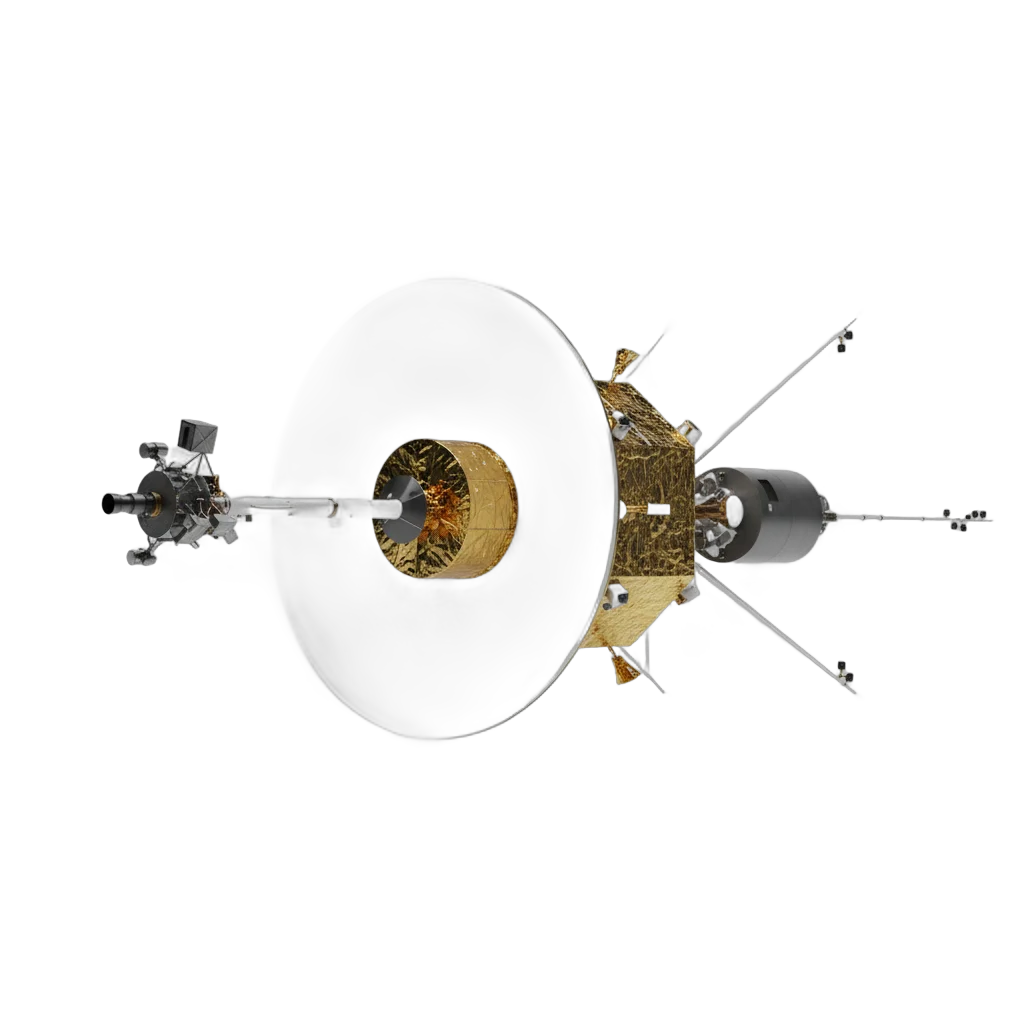
In the early 1970s, NASA engineers realized that a rare alignment of the outer planets -- one that occurs roughly every 176 years -- would allow a single spacecraft to visit Jupiter, Saturn, Uranus, and Neptune using gravity assists. The window opened in the late 1970s. Two identical spacecraft, Voyager 1 and Voyager 2, were built to seize the opportunity. They carried computers with less processing power than a modern key fob.
Voyager 1 reached Jupiter in March 1979 and transformed our understanding of the solar system overnight. It discovered active volcanoes on the moon Io -- the first volcanic activity ever observed on another world. It revealed the intricate banding and storm systems of Jupiter's atmosphere in unprecedented detail. The Great Red Spot, known for centuries as a vague smudge through telescopes, was revealed as a storm larger than Earth with wind speeds exceeding 400 mph.
At Saturn, Voyager 1 provided the first detailed images of the ring system's astonishing complexity -- thousands of individual ringlets, gaps, and braided structures maintained by shepherd moons. NASA redirected Voyager 1 for a close flyby of Titan, Saturn's largest moon, whose thick nitrogen atmosphere hinted at conditions reminiscent of early Earth. This trajectory flung the spacecraft out of the plane of the solar system, sacrificing any chance of visiting Uranus or Neptune.
On February 14, 1990, at Carl Sagan's request, Voyager 1 turned its camera back toward the inner solar system from a distance of 3.7 billion miles and captured the Pale Blue Dot -- Earth as a mote of dust suspended in a sunbeam. Sagan's reflection on the image became one of the most quoted passages in science: "Look again at that dot. That's here. That's home. That's us."
In August 2012, Voyager 1 crossed the heliopause and entered interstellar space -- the boundary where the Sun's influence gives way to the interstellar medium. It continues to transmit data back to Earth, its signal now taking over 22 hours to arrive. The Golden Record bolted to its side carries greetings in 55 languages, music from Bach to Chuck Berry, and the brainwaves of a young woman in love. It is humanity's most distant ambassador, and it is still calling home.